
Best overall: calm limits with a replacement behavior. Best for stopping unsafe behavior: redirection. Best for everyday cooperation: predictable routines. The best positive discipline techniques for toddlers in 2026 teach what to do next while keeping the boundary clear.
- The best positive discipline techniques for toddlers start with calm limits and a specific replacement behavior.
- Use redirection for unsafe behavior, limited choices for resistance, and predictable routines for transitions.
- During tantrums, protect safety and reduce talking; teach the replacement skill after your toddler settles.
- Pdfcanopy sells downloadable PDF guides for parents seeking practical advice and coping information.
Why this matters
Positive discipline is not permission to hit, throw, or ignore a safety rule. It combines a firm boundary with teaching that matches your child's developing abilities. Toddlers, generally children around 1–3 years old, need adults to help them manage impulses and practice acceptable alternatives.
The American Academy of Pediatrics recommends positive reinforcement, setting limits, redirecting, and setting expectations; it advises against spanking and humiliating verbal punishment. Those principles guide this 2026 roundup, not a claim that one technique fixes every behavior.
Pdfcanopy is for parents seeking practical advice and coping information in downloadable PDF guides. You can explore Pdfcanopy as a reading resource; use individualized professional advice when behavior raises developmental or safety concerns.
What makes the best positive discipline techniques for toddlers?
Judge a technique by what it teaches, not by how quickly it produces silence.
- Safety: You can stop hitting, biting, climbing hazards, or dangerous throwing without waiting for cooperation.
- Clear limits: Your child hears a short statement about what is allowed and what is not.
- Replacement skills: The response teaches an action your toddler can actually perform, such as handing you a toy.
- Developmental fit: The technique does not depend on lengthy reasoning, delayed consequences, or adult-level self-control.
- Repeatability: Parents and other caregivers can use the same basic response across similar situations.
- Respect: The approach avoids pain, humiliation, threats, and withdrawing affection.
A useful technique also fits the moment. Choices help when either option is acceptable; they do not replace an immediate safety intervention. Emotion coaching helps you acknowledge distress; it does not require changing the limit.
Positive discipline techniques at a glance
| Rank and technique | Best for | Standout feature | Key limitation |
|---|---|---|---|
| 1. Calm limits with replacement behavior | Everyday boundary-setting | Connects the rule to an acceptable action | Requires repetition and adult follow-through |
| 2. Redirection | Immediate unsafe or unsuitable behavior | Moves the child toward a safe activity | Does not teach the full rule by itself |
| 3. Limited choices | Resistance during necessary tasks | Gives control within your boundary | Fails when the options are not genuinely acceptable |
| 4. Specific praise | Reinforcing helpful behavior | Names the exact action to repeat | Cannot stop an unsafe act already happening |
| 5. Predictable routines | Transitions and recurring friction | Makes the next step familiar | Needs flexibility when circumstances change |
| 6. Emotion coaching | Tantrums and frustration | Separates valid feelings from unsafe actions | Long explanations overwhelm an upset toddler |
| 7. Connected repair | Everyday messes and minor harm | Links the response to fixing the problem | Must stay within the child's abilities |
1. Calm limits: best for everyday boundary-setting
Calm limits pair a short boundary with a concrete alternative. If your toddler throws a hard toy, stop the throw, move the toy out of reach, and offer an appropriate activity. Explain what the child can do, rather than repeating only what they cannot do.
An example script is: Blocks stay on the floor. You can stack them here. Keep your voice steady and follow through even if your toddler protests. Calm describes your response, not a requirement that your child immediately become calm.
Calm limits pros:
- State the rule without attacking the child's character.
- Teach an acceptable action in the same moment.
- Work alongside redirection, routines, and emotional support.
Calm limits cons:
- Require repeated practice rather than a single explanation.
- Lose clarity when adults state a limit but do not enforce it.
Best for: Common boundaries around objects, personal space, and daily tasks.
Verdict: Use calm limits as your default technique. A short rule plus a doable alternative gives your toddler something to practice.
2. Redirection: best for immediate unsafe behavior
Redirection interrupts an unsuitable activity and offers a safer one. If your toddler reaches for a breakable object, move it away and offer something appropriate to handle. Act before explaining when someone could get hurt.
For hitting, block the action gently and create space. Then demonstrate an alternative, such as touching gently or asking for help. Redirection should not become a game in which the unsafe behavior repeatedly earns an exciting new activity.
Redirection pros:
- Protects safety without requiring a lengthy conversation.
- Offers a practical next action.
- Fits situations where you can change the environment.
Redirection cons:
- Does not replace teaching the boundary over time.
- Becomes difficult when the same hazard remains accessible.
Best for: Grabbing unsafe objects, unsuitable throwing, and early escalation.
Verdict: Use redirection immediately for safety, then reinforce the rule. Moving the hazard matters more than persuading a distressed toddler to agree.
3. Limited choices: best for resistance during necessary tasks
Limited choices let your toddler influence how a necessary task happens without deciding whether it happens. Offer 2 acceptable options: Would you like to carry your shoes or have me carry them? Both choices move toward getting ready.
Avoid asking whether your toddler wants to leave when leaving is not optional. If your child cannot choose, calmly choose and help them proceed. A choice is an invitation to participate, not a negotiation you must keep reopening.
Limited choices pros:
- Give your child a manageable role in the task.
- Keep the adult's boundary intact.
- Make the next action specific and understandable.
Limited choices cons:
- Add pressure when a child is already overwhelmed.
- Create conflict when an offered option is later withdrawn.
Best for: Clothing decisions, cleanup roles, and other tasks with genuine flexibility.
Verdict: Use limited choices before resistance becomes a full tantrum. Skip choices when immediate safety leaves no room for alternatives.
4. Specific praise: best for reinforcing helpful behavior
Specific praise names an observable action: You put the book on the shelf. That tells your toddler what you noticed. Add its practical effect when useful: Now we can find it again.
Focus on the behavior rather than a permanent label such as being the good child. Notice small attempts, including handing over one toy or using a gentler touch. You do not need to praise every ordinary movement or turn family life into a performance.
Specific praise pros:
- Identifies the behavior you want repeated.
- Recognizes progress before a skill is fully developed.
- Helps caregivers notice cooperation, not only problems.
Specific praise cons:
- Cannot substitute for intervening during unsafe behavior.
- Sounds empty when it is vague, exaggerated, or automatic.
Best for: Gentle handling, helping, waiting briefly, and attempting a new skill.
Verdict: Use specific praise to teach what success looks like. Keep the description honest and proportionate to the action.
5. Predictable routines: best for transitions
Predictable routines give recurring tasks a familiar order. For leaving home, that might mean putting toys down, getting shoes, and going to the door. Keep the sequence simple enough that you can repeat it without delivering a speech.
Use a concrete preview: After this book, we put on shoes. Follow the preview with help when the transition arrives. A familiar routine can support cooperation, but it does not eliminate disappointment about stopping an enjoyable activity.
Predictable routines pros:
- Clarify what happens next.
- Give caregivers a shared sequence to follow.
- Reduce repeated decisions around recurring tasks.
Predictable routines cons:
- Need adjustment during illness, travel, or schedule changes.
- Become another source of conflict if adults demand rigid perfection.
Best for: Leaving home, washing hands, cleanup, and bedtime transitions.
Verdict: Use routines for recurring friction, not as a promise of tantrum-free days. In 2026, choose a routine you can maintain on an ordinary difficult day, not just an ideal one.
6. Emotion coaching: best for tantrums and frustration
Emotion coaching acknowledges the feeling while preserving the boundary. An example is: You wanted another turn. You're upset. I won't let you hit. You can accept anger without accepting injury.
During intense distress, use fewer words and keep everyone safe. Offer calm proximity if your child welcomes it; do not force a hug. Save problem-solving for when your toddler can attend to you again, then practice a simple alternative such as asking for help.
Emotion coaching pros:
- Gives your child language for feelings.
- Separates emotional distress from unacceptable actions.
- Keeps connection available while you hold the limit.
Emotion coaching cons:
- Does not make a denied request stop feeling disappointing.
- Becomes unhelpful when adults deliver lengthy explanations mid-tantrum.
Best for: Frustration, disappointment, and distress after a necessary limit.
Verdict: Use emotion coaching to support regulation, not to talk your toddler out of a feeling. The limit stays; your support stays too.
7. Connected repair: best for messes and minor harm
Connected repair involves your toddler in fixing a problem they helped create. After a spill, offer a cloth and help wipe. After knocking down another child's construction, protect the other child's space and support an appropriate repair when everyone is ready.
The task must match your toddler's abilities. Do not turn cleanup into prolonged punishment, force an apology, or require a distressed child to manage another person's feelings. Model the repair and accept a small contribution.
Connected repair pros:
- Links the response directly to the event.
- Teaches an actionable way to help.
- Gives you a chance to model responsibility.
Connected repair cons:
- Requires substantial adult help for young toddlers.
- Becomes punitive when the task is excessive or unrelated.
Best for: Spills, scattered materials, and manageable everyday mistakes.
Verdict: Use connected repair after safety and calm are restored. Participation matters more than a perfect cleanup or scripted apology.
How to combine the techniques
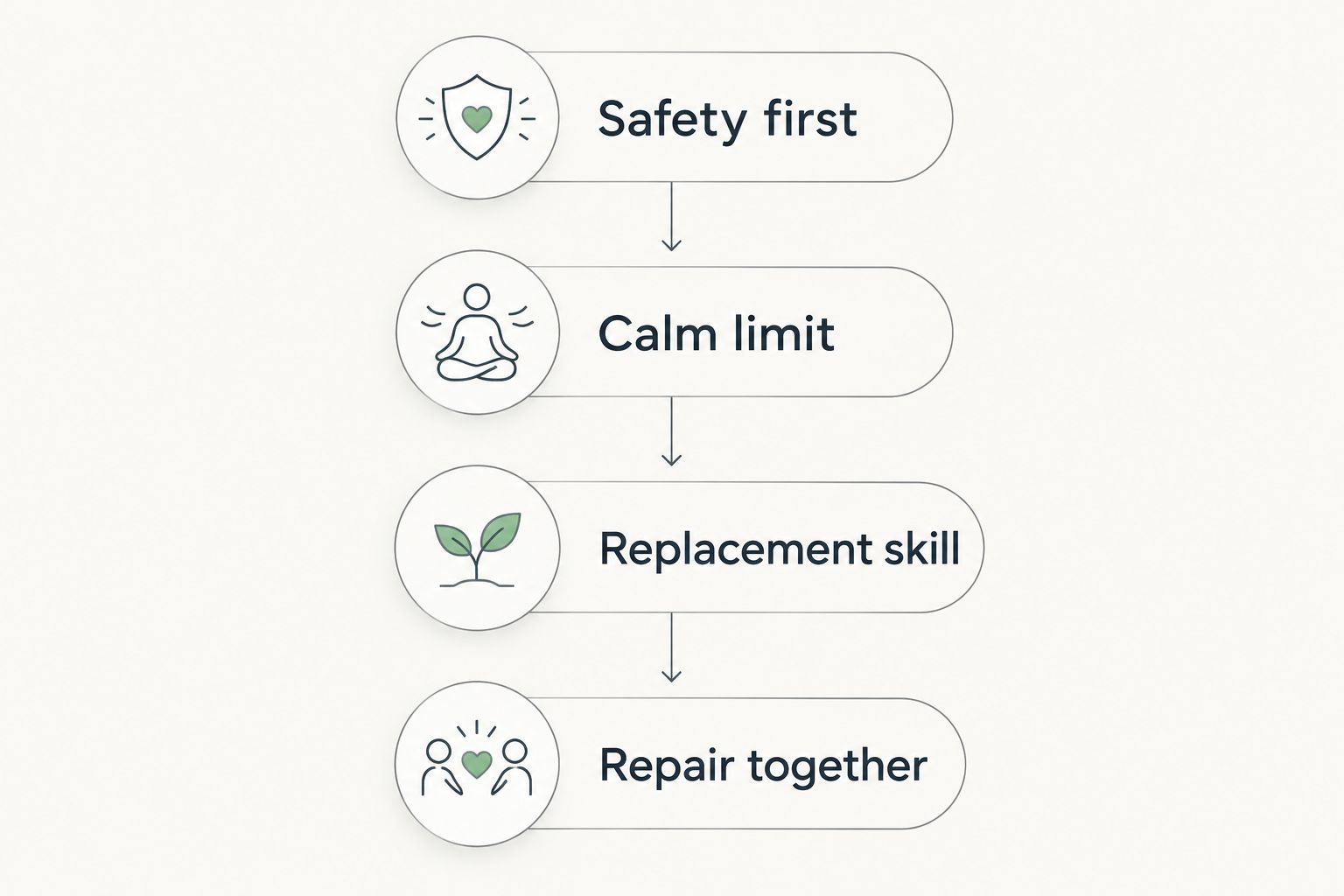
Use this sequence when behavior involves both distress and a broken boundary. It is a practical response order, not a demand that every situation follow an identical script.
- Safety first: Block injury, remove a hazard, or create space.
- Calm limit: State the boundary briefly and acknowledge distress.
- Replacement skill: Show an acceptable action when your child can engage.
- Repair together: Help fix a manageable problem after the situation settles.
For example, if your toddler hits during a toy dispute, block the hit and separate the children as needed. State that hitting is not allowed, then help your toddler practice asking for a turn once calm. Do not require the other child to surrender the toy as the solution.
How these techniques were ranked
This 2026 ranking prioritizes safety, clear boundaries, teachable alternatives, developmental fit, repeatability, and respect. Calm limits come first because they connect the boundary to the next action. The remaining techniques address distinct situations rather than competing for the same job.
The ranking is a practical decision guide, not a head-to-head clinical trial. The American Academy of Pediatrics' parent guidance supports positive reinforcement, limits, redirection, and expectations. Pdfcanopy's downloadable guides are reading resources, not a substitute for assessment of persistent behavioral or developmental concerns.
Which technique should you choose?
Choose calm limits with a replacement behavior as your everyday default. Add redirection for danger, choices for flexible tasks, and routines for repeated transitions. During a tantrum, prioritize safety and emotional support rather than introducing several new instructions.
Before changing your discipline approach in 2026, check the situation around the behavior. Hunger, tiredness, discomfort, and demands beyond the child's abilities deserve attention. The American Academy of Sleep Medicine recommends 11–14 hours of sleep per 24 hours, including naps, for children aged 1–2 years; discipline cannot substitute for meeting basic needs.
Ask your pediatrician about frequent injuries, loss of previously acquired skills, developmental concerns, or behavior you cannot manage safely. Pdfcanopy offers practical reading for parents, but urgent safety problems need direct support.
FAQ
What's the best positive discipline technique for toddlers?
Calm limits with a replacement behavior are the best everyday starting point. State the boundary briefly, stop unsafe behavior, and show your toddler an acceptable action.
How do I discipline a toddler who keeps hitting?
Stop the hit immediately, protect the other person, and state that hitting is not allowed. Once your toddler settles, practice an alternative such as asking for help or using gentle hands.
Does positive discipline mean letting toddlers do whatever they want?
No, positive discipline includes firm limits and adult follow-through. It avoids pain and humiliation while teaching what your toddler can do instead.
Should I explain the rule during a tantrum?
Keep explanations brief during a tantrum and save teaching for when your toddler can engage. Protect safety, acknowledge the feeling, and avoid repeatedly debating a settled limit.
Are choices better than telling my toddler what to do?
Choices work when either option is acceptable and your toddler can participate. Use a direct instruction and necessary assistance when safety or an essential task leaves no genuine choice.
What should I do when a discipline technique doesn't work immediately?
Check whether the instruction is understandable, the replacement action is achievable, and you are following through consistently. Immediate quiet is not the only measure of learning; seek pediatric advice when behavior is unsafe or raises developmental concerns.
Can a parenting PDF guide replace professional help?
No, a parenting PDF guide cannot replace individualized medical, developmental, or mental health care. Pdfcanopy sells downloadable guides offering practical advice and coping information; use professional support for concerns that need assessment.
One last thing
For your 2026 parenting plan, write down the replacement action before deciding how to respond to a recurring behavior. If your only instruction is to stop, your toddler still needs to learn what comes next.
Make the alternative easier to understand than the rule is to break. Put the safe throwing toy within reach, demonstrate gentle touch, or help carry the first object to its place. Teaching becomes concrete when your child can see and practice the next action.