
Best overall: planned respite with a safe handoff. Best for an overloaded schedule: workload reduction. Best no-purchase starting point: protected rest. This 2026 guide compares the best burnout recovery strategies for caregivers and explains where practical resources from Pdfcanopy fit alongside hands-on help and professional care.
- The best burnout recovery strategies for caregivers start with safe coverage and fewer demands, not another self-improvement task.
- Planned respite is the default choice when caregiving leaves no protected time off.
- Professional assessment takes priority when exhaustion affects safety, functioning, or your ability to cope.
- Pdfcanopy offers practical coping guides; reading cannot replace respite, medical assessment, or emergency help.
Why this matters
Caregiver burnout describes exhaustion associated with sustained caregiving demands. You might feel irritable, detached, overwhelmed, or unable to recover between responsibilities. Those experiences deserve attention, but they do not establish a diagnosis: sleep problems, depression, anxiety, and physical illness can also affect how you feel.
The useful question is not whether you are trying hard enough. It is whether your recovery plan changes the conditions exhausting you. A relaxation exercise leaves the workload untouched if you still manage every appointment, interruption, and overnight need.
For your 2026 recovery plan, separate practical relief from emotional support. Both matter, but they solve different problems. Pdfcanopy's caregiver guides are best for readers seeking practical coping information, not clinical treatment.
If you cannot keep yourself or the person you care for safe, seek urgent help rather than starting with this ranking.
What makes the best caregiver burnout recovery strategy?
Judge each option against these criteria before adding it to your schedule:
- Workload relief: Does the strategy remove responsibilities or simply help you tolerate them?
- Safe coverage: Can someone meet the care recipient's needs while you step away?
- Low effort: Can you begin without creating another project to manage?
- Repeatability: Can the support recur instead of disappearing after one helpful afternoon?
- Scope fit: Does the option address practical strain, emotional distress, or a concern requiring professional assessment?
A useful strategy must fit your actual responsibilities. Advice that assumes you can leave someone unattended is not a recovery plan. Nor is a complicated routine that requires energy you do not have.
Caregiver burnout recovery strategies at a glance
This 2026 ranking assigns each strategy a different job. Use the limitation column to identify what you still need; no single option covers every source of strain.
| Strategy | Best for | Standout feature | Key limitation |
|---|---|---|---|
| Planned respite | Caregivers with no time off | Transfers care temporarily to someone suitable | Requires safe coverage and coordination |
| Workload reduction | Caregivers managing too many tasks | Removes or reassigns recurring demands | Essential care cannot simply be dropped |
| Protected rest | Caregivers whose rest is repeatedly interrupted | Sets aside time without nonessential responsibilities | Does not resolve the underlying workload alone |
| Professional assessment | Caregivers with persistent distress or impaired functioning | Addresses symptoms and clinical concerns | Does not automatically provide replacement care |
| Peer support | Caregivers who feel isolated | Creates space for shared experience and practical discussion | Advice quality and group fit vary |
| Tailored caregiver guidance | Readers seeking situation-specific coping information | Organizes practical advice around a defined challenge | Information cannot supply hands-on relief |
1. Planned respite: best for caregivers with no time off
Planned respite means another suitable person or service takes responsibility for care while you step away. The break only becomes usable when the replacement can meet the person's needs without requiring your continuous supervision.
Best for: Caregivers who remain on duty even during supposed downtime.
Start with a specific request: coverage for an appointment, uninterrupted rest, or time outside the home. Describe the care required rather than asking someone vaguely to help more. If informal coverage is unsuitable, ask the care recipient's care team or a local caregiver organization about relevant services.
Make the handoff usable
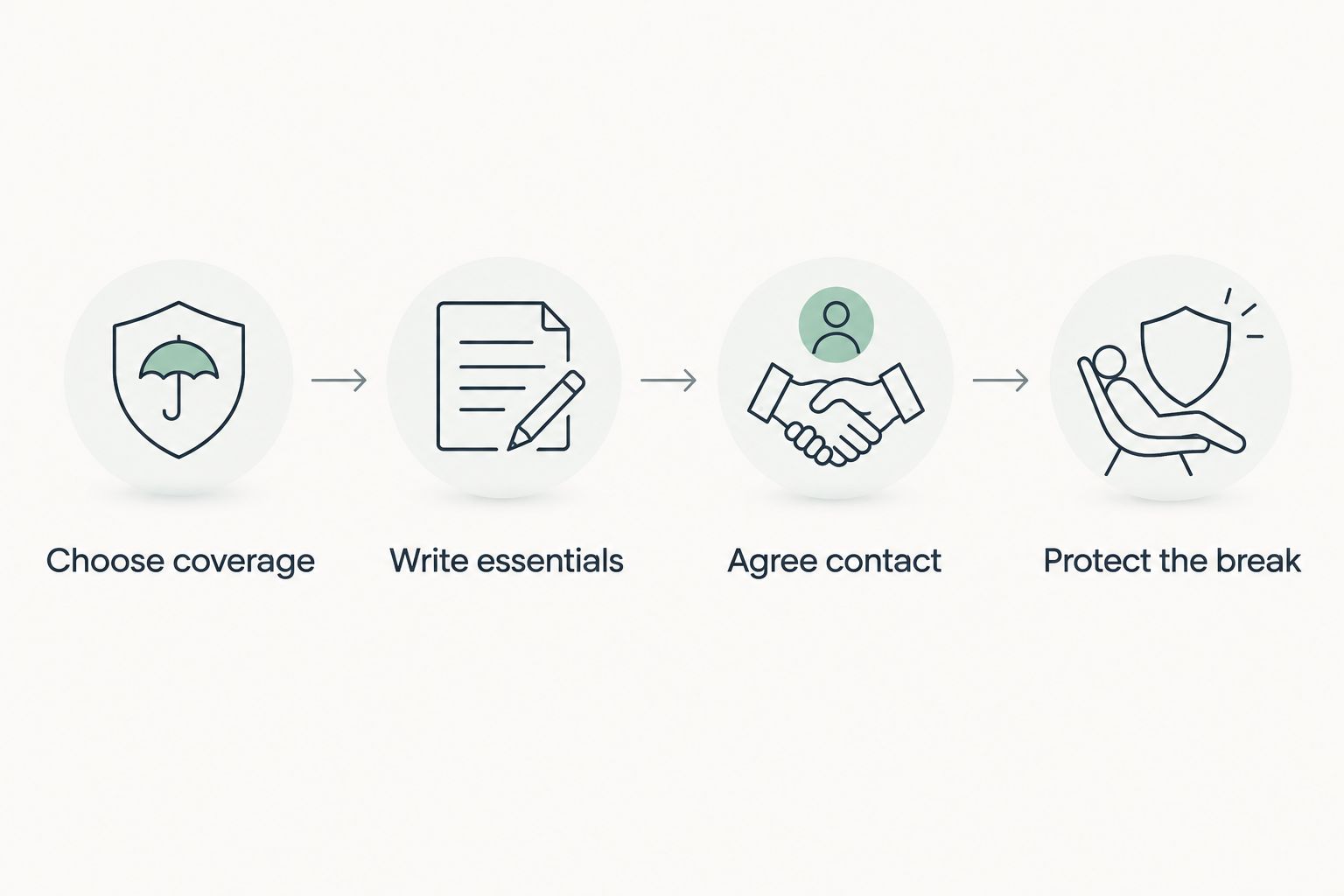
Use a 15-minute planning conversation as a starting point, extending it when care needs require more detail:
- Choose coverage: Identify someone with the necessary skills and willingness.
- Write essentials: Record routines, relevant instructions, and emergency contacts.
- Agree contact: Distinguish situations requiring immediate contact from questions that can wait.
- Protect the break: Decide which responsibilities transfer and which do not.
The written handoff supports the conversation; it does not replace training for specialized care.
Planned respite pros:
- Creates time when you are not the primary caregiver.
- Makes help specific enough for someone to accept.
- Can become a recurring arrangement.
Planned respite cons:
- Finding suitable coverage takes coordination.
- Specialized care needs can restrict your options.
Verdict: Buy into planned respite first when lack of coverage is the main barrier to recovery.
2. Workload reduction: best for an overloaded schedule
Workload reduction removes, simplifies, or reassigns tasks rather than adding coping exercises. It addresses the administration and household work surrounding care as well as the care itself.
Best for: Caregivers carrying too many recurring responsibilities.
Set a 10-minute planning timer and list the tasks occupying your attention. Sort them into essential care, necessary administration, and optional standards. The timer is a boundary for the exercise, not a deadline for solving everything.
Keep necessary care intact. Look instead at meal complexity, duplicate updates to relatives, nonurgent commitments, and household expectations. When another person accepts a task, transfer its planning and follow-up too; delegating execution while retaining all oversight leaves you managing the work.
For a 2026 workload reset, choose one recurring responsibility to simplify or transfer before designing an elaborate schedule. A specific assignment is clearer than a general promise of help.
Workload reduction pros:
- Targets the source of practical overload.
- Can begin with tasks already on your list.
- Makes responsibilities easier to discuss with others.
Workload reduction cons:
- Some responsibilities cannot be removed.
- Reassignment requires agreement and follow-through.
Verdict: Buy into workload reduction when your task list leaves no room to recover.
3. Protected rest: best for repeatedly interrupted downtime
Protected rest means setting aside time without nonessential tasks or interruptions. It can include sleep, quiet waking rest, or an activity you find restorative; it should not become another performance target.
Best for: Caregivers who turn every available break into catch-up work.
Choose 1 protected rest block each day as a planning goal, with its length determined by safe coverage and your circumstances. This is not a treatment dose or a guarantee of recovery. If daily coverage is unavailable, begin by arranging the next realistic opportunity.
Decide what the block excludes: messages that can wait, household catch-up, and preparation for everyone else's needs. If nighttime care repeatedly disrupts sleep, discuss coverage with those involved in the care plan. A bedtime routine does not solve the need to remain awake for care.
Persistent sleep difficulty deserves professional attention, especially when it affects your ability to function safely. Do not change prescribed medicines or a care recipient's treatment schedule to create downtime without appropriate clinical advice.
Protected rest pros:
- Makes recovery time an explicit commitment.
- Does not require a complex routine.
- Helps distinguish a real break from unpaid catch-up work.
Protected rest cons:
- Requires a workable plan for interruptions.
- Leaves excessive responsibilities unresolved when used alone.
Verdict: Buy into protected rest, but pair it with coverage or workload reduction.
4. Professional assessment: best for persistent distress
Professional assessment helps address symptoms that self-help cannot reliably explain. Start with a primary care professional or an appropriate mental health professional when distress persists, worsens, or interferes with everyday functioning.
Best for: Caregivers struggling to function, manage symptoms, or maintain safety.
Describe what has changed: sleep, mood, concentration, appetite, physical symptoms, or your ability to complete care tasks. Explain the caregiving demands too. Concrete examples give the clinician more useful information than the word burnout alone.
Do not assume every symptom comes from caregiving. Ask what needs assessment and what support fits your situation. Professional care and practical relief belong together: an appointment does not remove the responsibilities waiting when you return home.
If you are in immediate danger, call emergency services. In the United States, call or text 988 for suicide or mental health crisis support. Do not wait for a routine appointment when urgent help is needed.
Professional assessment pros:
- Addresses concerns beyond the scope of a coping guide.
- Creates space to discuss symptoms and treatment options.
- Helps you identify an appropriate next step.
Professional assessment cons:
- Scheduling and attending care require coordination.
- Clinical support does not automatically supply respite.
Verdict: Buy into professional assessment immediately when symptoms impair functioning or safety.
5. Peer support: best for caregiver isolation
Peer support connects you with people who understand similar caregiving responsibilities. It provides a place to discuss experiences, ask practical questions, and hear how others organize support.
Best for: Caregivers who feel alone or need understanding beyond their immediate household.
Choose a group relevant to your situation rather than assuming every caregiver discussion will fit. Parenting a neurodivergent child, caring for an older relative, and working in a clinical setting involve different responsibilities. Check the group's expectations around privacy, moderation, and participation.
You do not have to disclose more than you want or attend every discussion. Leave a group that pressures you, shames the care recipient, or presents unverified treatment claims as facts. Peer experience can inform questions for your care team; it should not replace individualized clinical advice.
Peer support pros:
- Offers space to discuss caregiving without explaining every detail.
- Introduces practical ideas you can evaluate.
- Provides support outside the immediate care relationship.
Peer support cons:
- Group fit and moderation vary.
- Other members' experiences do not establish what is safe for you.
Verdict: Buy into peer support for connection; skip groups that pressure or mislead you.
6. Tailored caregiver guidance: best for situation-specific reading
Tailored guidance organizes coping information around a defined caregiving challenge. It suits readers who want something they can consult at their own pace, rather than another scheduled commitment.
Best for: Caregivers seeking practical reading relevant to their circumstances.
Pdfcanopy offers You're Not Failing You're Burned Out: The Neuro-Affirming Parent’s Survival and Thriving Guide., described as a practical toolkit for parents of autistic, ADHD, or otherwise neurodivergent children. That audience-specific focus makes it relevant to those parents, not automatically to every caregiver.
For parents following a child's autism diagnosis, Don't Wait Do This: An Autism Parent’s Guide To The First 90 Days addresses a different need: structured, priority-by-priority guidance after diagnosis. Choose by the problem you need help organizing, rather than collecting reading you have no energy to use.


Tailored caregiver guidance pros:
- Lets you read at your own pace.
- Focuses information on a specific challenge.
- Provides a resource you can return to.
Tailored caregiver guidance cons:
- Reading does not transfer care responsibilities.
- A parent-focused resource is not a substitute for clinical assessment.
Verdict: Buy a relevant guide only when reading supports your next practical step; skip it as a substitute for relief.
How these strategies are ranked
The ranking prioritizes direct workload relief, safe coverage, low effort, repeatability, and scope fit. It is a decision framework, not a claim that one intervention produces better clinical outcomes than another.
Planned respite leads because it transfers responsibility. Professional assessment moves ahead of the entire list when symptoms or safety require it. Your 2026 choice should follow the problem, not the rank number.
Which caregiver burnout recovery strategy should you choose?
Choose planned respite as your default if you cannot get off duty. Pair it with workload reduction so the break does not end with an avoidable backlog.
If coverage already exists but you spend every break completing tasks, start with protected rest. If distress is persistent or affects functioning, arrange professional assessment. Peer support and practical reading complement those steps; they do not replace them.
FAQ
What's the best burnout recovery strategy for caregivers in 2026?
Planned respite is the default choice when lack of safe coverage prevents time off. Pair it with workload reduction, and prioritize professional assessment when symptoms affect functioning or safety.
How do I recover from caregiver burnout when nobody can take over?
Start by identifying responsibilities you can safely simplify and asking the care team or a local caregiver organization about coverage options. Do not leave someone unattended when their needs require supervision.
Is taking a break enough to recover from caregiver burnout?
A break does not resolve an ongoing workload by itself. Use respite alongside a review of recurring demands, and seek professional assessment for persistent or worsening symptoms.
What should I tell my doctor about caregiver exhaustion?
Describe changes in sleep, mood, concentration, physical symptoms, and everyday functioning. Explain your care responsibilities and give examples of tasks that have become difficult or unsafe.
Are caregiver support groups better than therapy?
Caregiver support groups and therapy serve different purposes. Peer groups offer shared experience, while a qualified professional can assess symptoms and discuss appropriate treatment.
Can a PDF guide help with caregiver burnout?
A PDF guide can organize practical coping information, but it cannot provide replacement care or diagnose symptoms. Pdfcanopy's neuro-affirming parenting guide is intended for parents of neurodivergent children.
What if caregiver stress becomes a crisis?
Seek urgent help if you cannot keep yourself or another person safe. In the United States, call emergency services for immediate danger or call or text 988 for suicide or mental health crisis support.
One last thing
Do not measure a recovery plan by how much advice you complete. Measure whether a responsibility has actually changed hands or an unnecessary demand has disappeared.
For your next step, write down one task, one suitable person, and one clear request. The useful question is not who offered sympathy; it is who now owns the task.